
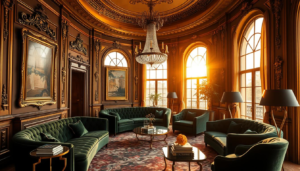
The world of interior design is seeing a big comeback of Rococo Revival. This style, known for its bold and ornate features, is now a big part of modern interior design. It brings a sense of luxury and grandeur to our homes.
What Is Rococo Revival?
“Rococo Revival is a 19th-century style that reinterprets the ornate and decorative elements of 18th-century Rococo. It features intricate carvings, elaborate patterns, and a pastel color palette, creating opulent interiors that exude elegance and charm.”
Source: https://www.vinas-geneve.com/definitions/rococo-revival

This revival isn’t just about copying the old. It’s about making the classic Rococo style fit today’s homes. Designers are adding detailed patterns, curved lines, and gold touches to their work. This creates spaces that are both fancy and welcoming.
Key Takeaways
- The Rococo Revival style is making a comeback in modern interior design.
- This style is characterized by bold and ornate elements.
- Designers are reinterpreting classic Rococo elements in contemporary contexts.
- The result is luxurious and inviting spaces.
- Rococo Revival brings a sense of opulence and grandeur to interiors.
The Resurgence of Ornate Design in Modern Homes
People are moving away from simple designs and towards Rococo Revival. This change is not just a reaction to simple designs. It’s a cultural move towards embracing luxury and detailed designs in homes.

The Cultural Shift Toward Maximalism
The trend towards maximalism means wanting richer, more detailed environments. Homeowners want spaces that are not just useful but also show their personality. They use complex patterns, vibrant colors, and fancy furniture to do this.
This shift is because of a love for the unique and the handmade. It’s also a pushback against design that looks too similar.
Reaction to Minimalist Fatigue
As the cold, uninviting feel of minimalist interiors becomes tiresome, people seek warmer, welcoming spaces. The Rococo Revival brings back the warmth and character that minimalist designs often miss.
By adding Rococo Revival elements, homeowners can make spaces that feel both fancy and personal. This breaks the monotony of minimalist designs.
Understanding the Original Rococo Movement
Rococo is known for its fancy decorations and playful designs. It started in 18th century France. It was a change from the strict Baroque style, making rooms feel cozy and intimate.
The 18th century origins of Rococo in France changed the art and culture scene. This was when the style really took off, mainly in decorative arts.
18th Century Origins in France
In the early 18th century, France saw the birth of Rococo. It was all about soft colors, gold details, and detailed patterns. Artists like Jean-Antoine Watteau and François Boucher made it famous.

Key Historical Characteristics
The historical characteristics of Rococo include its love for balance, natural themes, and fun. These traits made it a unique look that was both fancy and fun.
| Characteristic | Description |
|---|---|
| Asymmetry | Rococo designs often feature asymmetrical compositions, adding to their whimsical nature. |
| Natural Motifs | The use of natural motifs, such as shells and foliage, was a hallmark of Rococo design. |
| Playfulness | Rococo interiors were designed to be playful and engaging, often featuring intricatet patterns and gilded details. |
Knowing these historical characteristics helps us understand the Rococo revival in today’s design. Designers can make spaces that are both classy and fun by tapping into the original Rococo spirit.
What Defines Rococo Revival in Today’s Interior Design
The Rococo Revival style is making a bold statement in modern interior design. It blends historical elements with a modern twist. This style brings back the opulence and detail of the original Rococo movement.
Rococo Revival in today’s design is not just about copying the past. It’s about making historical elements feel new and relevant. Designers must mix the ornate details of Rococo with modern minimalism.
Contemporary Interpretations vs. Historical Accuracy
One big challenge in Rococo Revival design is finding the right balance. Designers must blend modern touches with historical accuracy. Some stick to the past, while others mix in modern materials and techniques.
A modern Rococo Revival living room might have traditional curved lines and asymmetrical patterns. But it also includes modern furniture. This mix of old and new creates a unique look that respects history and modernity.
The Balance Between Opulence and Restraint
Finding the right balance between opulence and restraint is key in Rococo Revival design. Too much decoration can be overwhelming. Too little can make a space feel empty. Designers must find the perfect amount of detail and luxury to create a welcoming space.
“The key to successfully incorporating Rococo Revival elements into modern design is to strike a balance between opulence and restraint, allowing the beauty of the details to shine through without overwhelming the space.”
| Design Element | Historical Accuracy | Contemporary Interpretation |
|---|---|---|
| Curved Lines | Ornate, intricately carved | Simplified, modern materials |
| Asymmetrical Patterns | Complex, detailed motifs | Abstracted, minimalist designs |

Essential Elements of Modern Rococo Aesthetics
Modern Rococo stands out in interior design with its curved lines and ornate details. It blends the luxury of 18th-century Rococo with a modern twist. This creates spaces that are both lavish and playful.
Curved Lines and Asymmetrical Patterns
Curved lines and asymmetrical patterns are key in Modern Rococo. They bring a sense of movement and fun to a room. Unlike strict, modern designs, these elements add a playful touch.
Curved lines can show up in furniture, building details, or decorations.
Ornate Detailing and Motifs
Ornate detailing is a big part of Modern Rococo. It includes detailed patterns, gold accents, and complex designs. These add depth and interest to a space.
Ornate details can be found in carved wood, metalwork, or decorative plaster.
Lightness and Whimsy in Design
Modern Rococo also has a light and playful side. It uses soft colors, fine patterns, and light textures. This balances the richness of the ornate details.
The result is a design that feels both grand and welcoming.
| Element | Description | Examples |
|---|---|---|
| Curved Lines | Adds fluidity and playfulness | Furniture, architectural details, decorative motifs |
| Ornate Detailing | Adds depth and visual interest | Carved wood, metalwork, decorative plaster |
| Lightness and Whimsy | Balances opulence with delicacy | Pastel colors, delicate patterns, airy textures |

The Modern Rococo Color Palette
The Rococo revival is bringing back its color palette, mixing soft pastels with bright colors. This new take on Rococo isn’t just about old styles. It’s also about making them fit today’s tastes.

Traditional Pastels Reimagined
Modern interiors are using traditional pastels in new ways. Soft pinks, baby blues, and mint greens are paired with neutral colors. This keeps the space balanced and adds a touch of whimsy.
Bold Color Choices for Contemporary Spaces
Modern Rococo isn’t shy about bold colors. Deep jewel tones like emerald green and sapphire blue add luxury. These colors can make a room pop, used on walls, furniture, or accessories.
Metallics and Their Role in Modern Rococo
Metallics add opulence to modern Rococo. Gold, rose gold, and brass are used in lighting and decor. They reflect light and add glamour, making the space feel luxurious.
The modern Rococo color palette is a mix of old and new. It combines soft pastels, bold colors, and metallics. This creates a unique and captivating space that honors Rococo heritage while being modern.
Furniture and Accessories That Define Rococo Revival
The Rococo Revival style is making a bold statement in modern interior design. It uses ornate furniture and accessories. This style came from 18th-century France and is known for its detailed designs, curved lines, and luxurious materials.
Statement Pieces Worth Investing In
To truly embody the Rococo Revival style, one must invest in statement furniture pieces. These pieces are not just functional but also works of art.
Cabriole Legs and Carved Details
Furniture with cabriole legs and carved details are key to the Rococo Revival aesthetic. They add sophistication and elegance to any room.
Ornate Mirrors and Lighting Fixtures
Ornate mirrors and lighting fixtures are also statement pieces that elevate the Rococo Revival style. They add luxury and become focal points in a room.
Affordable Ways to Incorporate Rococo Elements
Incorporating Rococo Revival elements into your home doesn’t have to be expensive. There are several affordable ways to achieve this look. You can use decorative accessories and furniture reproductions.
- Using throw pillows and blankets with Rococo-inspired patterns
- Incorporating vintage or antique pieces into your decor
- Opting for furniture with Rococo-inspired designs instead of authentic antiques
Balancing Antiques with Modern Reproductions
To achieve a balanced look, mixing antique pieces with modern reproductions is key. This blend creates a unique and harmonious space. It honors the Rococo Revival style while keeping it contemporary.
By incorporating these elements and balancing statement pieces with more subdued elements, you can create a space that is both opulent and inviting.
Room-by-Room Guide to Implementing Rococo Revival
To bring Rococo Revival into your home, start by understanding each room’s unique charm. This way, you can make spaces that are not just pretty but also useful and welcoming.
Living Spaces: Creating Conversation Areas
In living rooms, Rococo Revival can help make cozy spots for talking. Curved sofas and ornate coffee tables draw people together. Arrange furniture in a circle to make these areas inviting.
Bedrooms: Achieving Romantic Opulence
Bedrooms are perfect for embracing Rococo Revival’s romantic flair. Use rich fabrics, detailed patterns, and gilded accents to make it a lavish sanctuary. A four-poster bed with heavy drapes and fancy furniture is a great start.
Dining Rooms: Entertaining with Elegance
Dining rooms are great for showing off Rococo Revival’s elegance. A grand chandelier can be a stunning centerpiece. Add an elaborately carved dining table and chairs for more charm. Don’t forget to include fancy china and crystal.
Bathrooms: Unexpected Luxury
Bathrooms can also get a luxury boost from Rococo Revival. Ornate mirrors and faucets with detailed designs add class. For an extra touch of luxury, use marble or other premium materials.
| Room | Rococo Revival Elements | Tips for Implementation |
|---|---|---|
| Living Spaces | Curved sofas, ornate coffee tables | Arrange furniture in a circular pattern |
| Bedrooms | Four-poster beds, rich fabrics, gilded accents | Use heavy drapes and ornate furnishings |
| Dining Rooms | Grand chandeliers, elaborately carved furniture | Add intricat china and crystal glassware |
| Bathrooms | Ornate mirrors, detailed faucet designs, marble | Use high-end materials for a luxurious feel |
Mixing Rococo Revival with Other Design Styles
Rococo Revival is very versatile. It can be mixed with many interior design styles. This creates spaces that are both unique and visually appealing.
Rococo Meets Minimalism: The Unexpected Pairing
Combining Rococo’s ornate details with minimalism’s simplicity is fascinating. Start with a minimalist base and add Rococo elements as accents. For example, a minimalist room can be enhanced with a Rococo-style chandelier or ornate mirror.
- Use Rococo patterns on accent pillows or throws.
- Incorporate minimalist furniture with Rococo detailing.
- Balance ornate pieces with simple, unadorned elements.
Industrial Elements with Ornate Details
Mixing industrial elements with Rococo Revival adds complexity to the design. Exposed brick or concrete can be a rugged backdrop for ornate Rococo furniture or accessories. This mix of hard and soft elements creates a dynamic visual experience.
Key elements to consider:
- Pair industrial lighting fixtures with Rococo-style wall decor.
- Use reclaimed wood furniture with Rococo carvings.
- Balance raw, industrial textures with luxurious fabrics.
Mid-Century Modern and Rococo Fusion
Fusing Mid-Century Modern with Rococo Revival combines organic and geometric forms with ornate detailing. This fusion results in a sophisticated and eclectic interior. To achieve this look, incorporate Mid-Century Modern furniture with Rococo-inspired patterns or accessories.
Tips for a successful fusion:
- Combine a Mid-Century Modern sofa with Rococo-patterned pillows.
- Use Rococo-style lighting fixtures in a room with Mid-Century Modern furniture.
- Balance the clean lines of Mid-Century Modern with the intricacy of Rococo.
By mixing Rococo Revival with other design styles, homeowners can create unique interiors. Whether through subtle accents or bold statements, the possibilities are endless.
DIY Projects to Add Rococo Revival Elements to Your Home
With a little creativity, you can add Rococo Revival flair to your home decor through DIY endeavors. This style, known for its opulence and intricacy, can be incorporated into your home through various projects. These projects are both fun and rewarding.
Gilding Techniques for Furniture and Frames
Gilding is a classic technique used in Rococo Revival design to add a touch of luxury. You can apply gilding to furniture and frames using gold leaf or metallic paint. Start by preparing the surface with a primer, then apply the gilding material using a brush or a specialized tool.
Creating Ornate Wall Treatments
Ornate wall treatments are a hallmark of Rococo Revival style. You can create your own using stencils, molding, or even wallpaper with Rococo-inspired designs. Consider adding a statement wall with a bold, ornate pattern to create a focal point in your room.
Upholstery Projects with Rococo-Inspired Fabrics
Upholstery is another area where you can incorporate Rococo Revival elements. Choose fabrics with intricacy and luxury, such as velvet or silk. Update your furniture with Rococo-inspired upholstery to add elegance and sophistication to your space.
| DIY Project | Materials Needed | Skill Level |
|---|---|---|
| Gilding Furniture | Gold leaf, primer, brush | Intermediate |
| Ornate Wall Treatments | Stencils, molding, wallpaper | Beginner |
| Rococo-Inspired Upholstery | Velvet, silk, upholstery tools | Advanced |
By incorporating these DIY projects into your home decor, you can achieve a look that is both luxurious and unique. Whether you’re gilding furniture, creating ornate wall treatments, or updating your upholstery, you’ll be adding a touch of Rococo Revival elegance to your space.
“The art of decoration is not about slaving away to create a perfect, Pinterest-worthy space; it’s about curating a home that reflects your personality and style.”
Conclusion: Embracing the New Age of Rococo
The return of Rococo Revival in interior design shows how styles come full circle. This ornate style is back, adding luxury and whimsy to our homes.
Knowing the history and key elements of Rococo Revival helps homeowners add it to their spaces. You can use statement furniture or DIY projects to bring this style home.
When embracing Rococo Revival, balance is key. Mix ornate details with simple pieces for a unique look. This way, you can make your home elegant and sophisticated, reflecting your style.
Ready to make a statement or just add some flair? The options are vast. So, why not dive into the beauty of Rococo Revival and see how it transforms your space?


